Small in size, essential in function — the cocktail jigger is the tool that separates a well-balanced drink from a poorly proportioned one. This guide covers everything you need to know: what a jigger is, where it came from, how it works, and how to choose the right one.
What Is a Jigger?
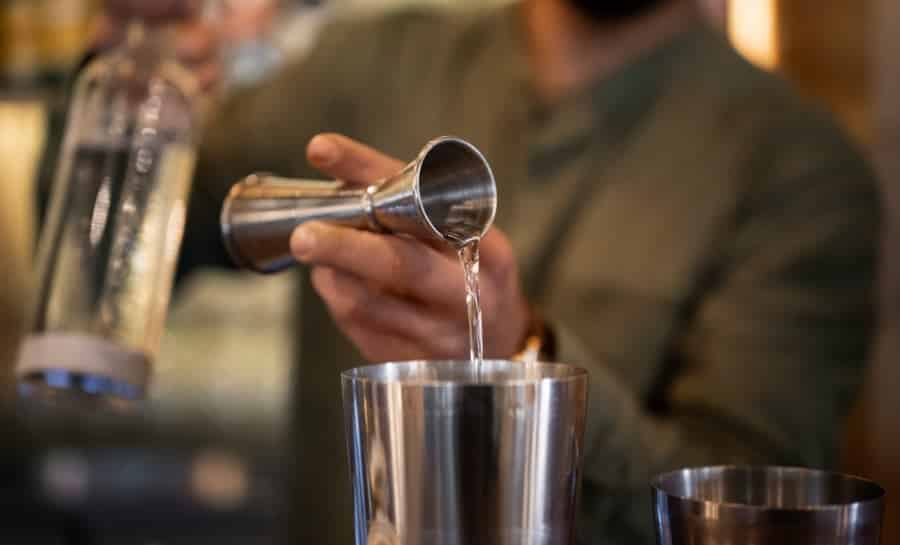
A jigger is a precision measuring tool used in bartending to pour accurate volumes of spirits and other liquid ingredients into a cocktail. It ensures that every drink is made to the same specification — the right ratio of spirits, modifiers, and mixers — which is the foundation of cocktail consistency and balance.
The name “jigger” refers both to the tool itself and, historically, to a specific unit of measurement: 1.5 fluid ounces (44ml), also known as one “jigger” in US bartending tradition. Today the term is used broadly to describe any bartending measuring tool, regardless of the specific volumes it measures.
In its most common form, a jigger is a small double-ended hourglass-shaped vessel — two conical cups joined at the base, each side measuring a different volume. One side is typically larger than the other, giving the bartender two precise measures in one compact tool. Single-sided and multi-cup designs are also widely used.
A Brief History of the Jigger
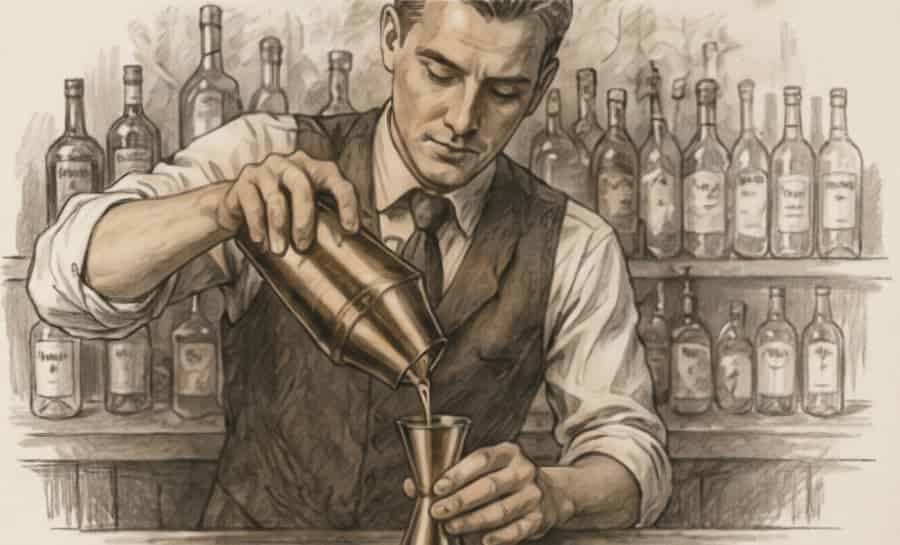
The word “jigger” has nautical origins. In 19th century seafaring, a “jigger” referred to a small measure of spirits — typically the daily ration of rum issued to sailors. The term made its way from ships to shore as bartending grew into a formalized craft in the late 1800s, a period that also saw the publication of the first major cocktail recipe books.
The earliest bar jiggers were simple thimble-like cups used to standardize spirit pours at a time when inconsistency was common. As cocktail culture matured through the early 20th century — and particularly during the post-Prohibition cocktail renaissance — the double-sided hourglass jigger became the standard form factor still in use today.
The 21st century craft cocktail revival brought renewed focus on precision measurement, elevating the jigger from a basic utility tool to a design object in its own right. Today’s jiggers range from plain functional doubles to precision-engraved Japanese-style measuring vessels, hammered-finish artisan pieces, and PVD-coated premium bar tools — reflecting how seriously the industry now takes both accuracy and aesthetics.
What Is a Jigger Used For?
A jigger’s primary purpose is accurate measurement — but the downstream benefits of that accuracy touch every aspect of cocktail quality:
Flavor balance — Cocktail recipes are built on ratios. The difference between 30ml and 45ml of a spirit, or between 15ml and 20ml of a liqueur, changes the flavor profile of the finished drink. A jigger ensures those ratios are hit precisely every time.
Consistency — In a bar environment, the same cocktail ordered at different times or made by different bartenders should taste identical. Jigger-based measuring makes this possible at scale.
Cost control — For commercial bars and hospitality programs, free-pouring without measuring leads to over-pours that add up significantly across a shift. Accurate jigger use is a standard part of bar cost management.
Compliance — In regulated markets such as the UK and parts of Europe, licensed premises are legally required to serve spirits in defined measures. A calibrated jigger is part of regulatory compliance, not just good practice.
Recipe development — For bartenders creating new cocktails, the jigger is the tool that translates a recipe idea into a repeatable, scalable specification.
How Does a Jigger Work?
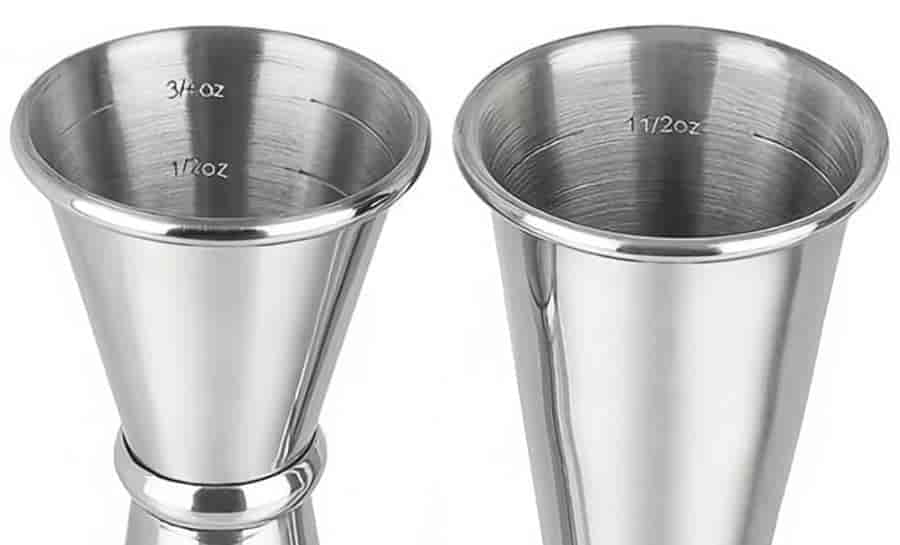
The basic principle is straightforward: fill the jigger to the rim (or to an internal mark), then pour the measured liquid into the shaker, mixing glass, or directly into the serving glass.
On a standard double jigger: The two conical cups — one on each end — hold different fixed volumes. The bartender tips the jigger to the desired side, fills it to the rim, and pours. No estimation, no guesswork.
On a jigger with internal markings: Laser-etched or stamped lines inside the cone allow measurement at multiple volumes within the same cup — not just the rim capacity. The bartender fills to the relevant line and pours. This adds significant versatility without requiring multiple tools.
On a multi-capacity jigger: Multiple individual cups of different volumes are arranged in a ring or star-shaped frame. The bartender selects the right cup by rotating the frame, fills it, and pours — the fastest format for accessing several different measures in quick succession.
Parts of a Jigger
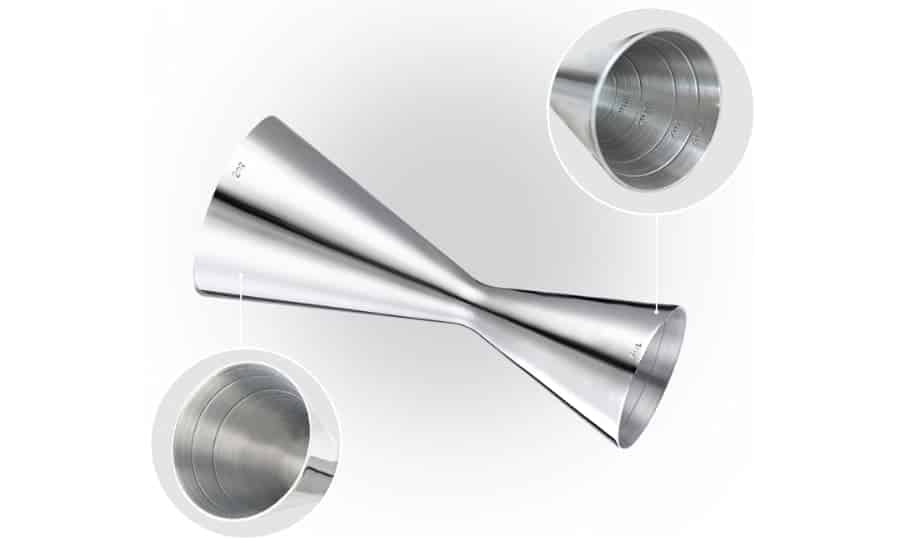
Understanding the parts of a jigger helps when specifying or comparing products:
Large cup (large side) — The bigger of the two conical cups on a double jigger. Typically holds the larger pour volume — commonly 60ml (2oz), 50ml (1⅔oz), or 45ml (1½oz) depending on the size combination.
Small cup (small side) — The smaller conical cup. Typically holds the modifier or secondary measure — commonly 30ml (1oz), 25ml (¾oz), or 20ml (⅔oz).
Rim — The lip at the opening of each cup. On a standard jigger, filling to the rim gives the cup’s full volume. On a rolled edge jigger, the rim curves outward for a more comfortable pour and reduced dripping.
Internal markings — Laser-etched or stamped lines inside the cup wall that indicate intermediate volumes. Present on some models; absent on standard double jiggers.
Base / waist — The point where the two cups meet. On a classic hourglass double jigger this is a narrow waist. On some modern designs (such as bell or straight styles) this junction takes a different form.
Handle — Present on handled jigger variants. Extends from the waist or base for ergonomic grip, particularly useful in high-volume service.
Types of Jiggers
Jiggers are available in a wide range of styles, each with different functional and aesthetic characteristics. Understanding the main types helps buyers and bartenders choose the right tool for their needs.
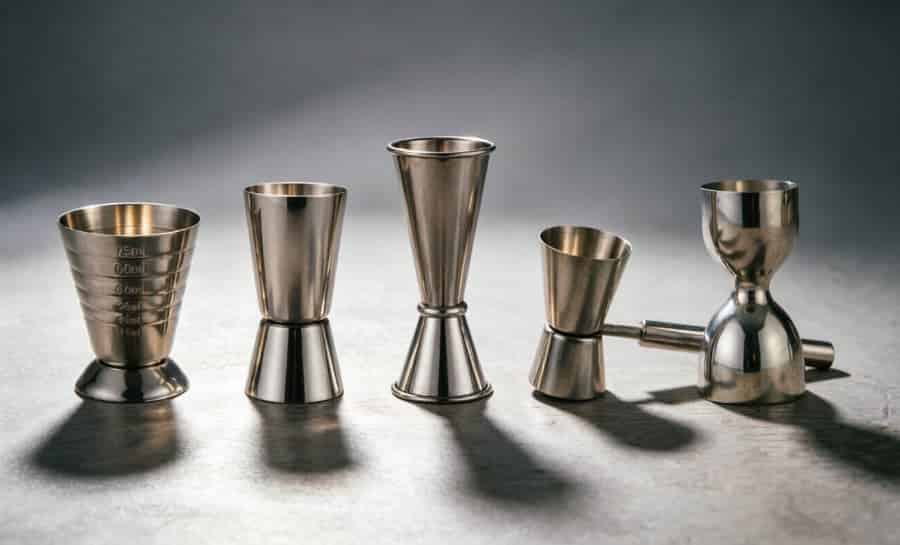
Double jigger (standard) — The classic hourglass shape with two fixed volumes and no internal markings. The professional standard in most bars worldwide. Available in a wide range of size combinations (15/30ml through 30/60ml).
Double jigger with rolled edge — Same hourglass construction with a smooth outward-curved rim on each cup. The rolled lip provides a cleaner, drip-free pour and a more refined aesthetic. Available with internal measurement markings on select sizes.
Double jigger with handle — An ergonomic long handle extends from the waist, allowing the bartender to pick up, tip, and pour the jigger with a full grip. Particularly useful in high-volume service and for bartenders who prefer not to pinch the waist.
Bell jigger — A Japanese-inspired design with a distinctive flared silhouette — wider at the rim than a standard cone, tapering to a narrower waist. Associated with the precision-focused aesthetic of Japanese bartending. Popular in premium bar programs and upscale hospitality gifting.
Multi-capacity jigger — Multiple individual measuring cups in different volumes arranged in a ring or star-shaped frame. Instant access to any measure without flipping or rotating — the fastest format for complex recipes requiring multiple precise volumes.
Stepped / graduated jigger — A cylindrical or tapered design with clearly defined volume steps rather than a smooth taper. Each step represents a specific volume, making it easy to read the fill level at a glance.
Spouted jigger — Features a small pour spout on the rim for directed, controlled pouring with minimal splash. Useful when pouring into narrow-necked bottles or precise locations.
→ See our full type breakdown: Types of Cocktail Jiggers: Single, Double, Multi-Capacity and How to Choose
Jigger Materials: What Are Jiggers Made Of?
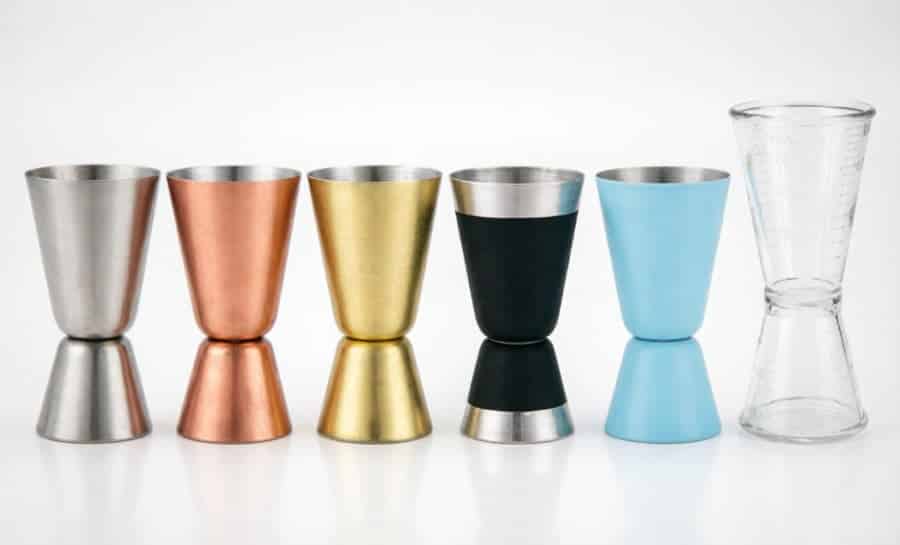
Stainless steel is the professional standard for cocktail jiggers and the material used in virtually all commercial bar tools. It is durable, non-reactive (will not affect the flavor of measured ingredients), easy to clean and sanitize, and maintains its finish under daily use.
Within stainless steel, the grade matters:
304 stainless steel (18/8) — 18% chromium and 8% nickel. The professional benchmark — excellent corrosion resistance, food-safe and FDA / LFGB compliant, compatible with a wide range of surface finishes. The right specification for professional-grade and premium retail jiggers.
201 stainless steel — Lower nickel content (3.5–5.5%), moderate corrosion resistance, lower cost. Suitable for value-tier and promotional products where budget is a primary consideration.
→ See our full material guide: 304 vs 201 Stainless Steel: What’s the Difference?
Surface finish options for stainless steel jiggers:
- Mirror polish — bright, reflective, classic bar aesthetic
- Brushed finish — matte linear texture, hides fingerprints
- Hammered finish — textured, artisan feel, strong shelf presence
- PVD color coating — gold, rose gold, black, gunmetal, rainbow — durable, food-safe color applied via physical vapor deposition
Glass jiggers — transparent, allowing the bartender to see the liquid level directly. Less common in professional settings due to fragility. Occasionally used in home bars for their visual clarity.
Plastic jiggers — lightweight and inexpensive, but not suitable for professional use. Prone to staining and flavor retention. Not recommended.
Jigger Sizes: What Are the Standard Measurements?
Jigger sizes vary by market region and recipe tradition. The most commonly used volumes are:
| Volume (ml) | Volume (oz) | Common use |
|---|---|---|
| 15ml | ½ oz | Modifier / liqueur pour |
| 20ml | ⅔ oz | UK small measure |
| 25ml | ¾ oz | UK single spirit (legal standard) |
| 30ml | 1 oz | US standard single |
| 45ml | 1½ oz | US standard jigger measure |
| 50ml | 1⅔ oz | UK double spirit (legal standard) |
| 60ml | 2 oz | US standard double |
| 75ml | 2½ oz | Large pour / multi-mark single jigger max |
The most universally stocked size is the 30ml / 60ml (1oz / 2oz) double jigger. For the UK and Irish markets, 25ml / 50ml is the legally mandated standard for licensed premises.
→ See our full size guide: Cocktail Jigger Sizes & Measurements: The Complete Guide
Jigger vs Shot Glass: What’s the Difference?
A common point of confusion — jiggers and shot glasses look similar but serve very different purposes:
| Jigger | Shot Glass | |
|---|---|---|
| Purpose | Precision measuring tool | Serving vessel |
| Markings | Calibrated volume marks | Usually none, or approximate |
| Accuracy | High — designed for consistent measurement | Low — not calibrated for accuracy |
| Material | Stainless steel (professional standard) | Glass (most common) |
| Use in bartending | Measuring ingredients before mixing | Serving a straight shot |
A shot glass can give a rough approximation of volume but is not calibrated for precision. In a professional bar context, using a shot glass to measure cocktail ingredients produces inconsistent results. A proper jigger is the right tool for the job.
Frequently Asked Questions
What does “jigger” mean in bartending?
In bartending, “jigger” refers to both the measuring tool and, historically, a unit of volume equal to 1.5 fl oz (approximately 44ml). Today the term is broadly used for any bartending measuring cup, regardless of specific volume.
Do professional bartenders use jiggers?
Yes — the vast majority of professional bartenders use jiggers for measured pours. Free-pouring (estimating volumes without a tool) is practiced by some experienced bartenders but is less accurate and not suitable for environments where consistency, cost control, or regulatory compliance matters.
What is a jigger measure in the UK?
In the UK, a jigger typically refers to the 25ml / 50ml double jigger — reflecting the legally mandated single (25ml) and double (50ml) spirit measures for licensed premises. Bars in the UK are legally required to serve spirits in these standardized volumes.
What is the difference between a jigger and a measure?
“Jigger” and “measure” are often used interchangeably in bartending. “Measure” is more commonly used in the UK to describe the regulated spirit measure tool; “jigger” is the more widely used term in the US and internationally.
Can I use a jigger for non-alcoholic ingredients?
Yes. Jiggers are used to measure any liquid ingredient in a cocktail recipe — spirits, liqueurs, juices, syrups, cream, egg white, bitters, and so on. Precise measurement of non-alcoholic modifiers is just as important as measuring the spirit for flavor balance.
What is the best jigger for a home bar?
For most home bartenders, a 30ml / 60ml double jigger is the best starting point — it covers the most common recipe measures and is the most universally understood size. If you want more precision and flexibility, a 30ml / 60ml with internal markings or a 75ml single jigger with marks at 15 / 20 / 30 / 45 / 60 / 75ml eliminates the need to estimate intermediate volumes.
Sourcing Jiggers for Your Business?
If you’re a bar supplier, importer, brand owner, or hospitality distributor looking to source cocktail jiggers at scale, we manufacture and wholesale the full range of jigger styles — double, rolled edge, handled, bell, single, stepped, spouted, and multi-capacity — for B2B clients worldwide.
Available configurations:
- Double jiggers: 15ml/30ml, 20ml/40ml, 25ml/50ml, 30ml/60ml, 30ml/45ml
- Double jiggers with internal markings: 25ml/50ml, 30ml/45ml, 30ml/60ml
- Single jigger with internal markings: up to 75ml (marks at 15/20/30/45/60/75ml)
- Measurement markings: ml only, oz only, or dual oz/ml
- Surface finishes: mirror polish, brushed, hammered, PVD color (gold, rose gold, black, gunmetal)
- Material: 304 stainless steel (18/8) standard; 201 available for value-tier orders
Why work with us:
- 🏭 Factory direct — competitive wholesale pricing across all jigger styles and sizes
- 🎨 Full OEM customization — custom logo (laser engraving, screen print, embossing), surface finish, measurement markings, and packaging
- ✅ Certified & compliant — FDA, LFGB (EU), and ISO certified; full material documentation provided
- 📦 Low MOQ — orders from 200 pcs per SKU
- 🌍 Global shipping — serving clients across North America, Europe, Australia, and Asia
Browse our cocktail jigger product range or contact us for custom OEM solutions.
Related reading: Types of Cocktail Jiggers: Single, Double, Multi-Capacity and How to Choose | Cocktail Jigger Sizes & Measurements: The Complete Guide | Cocktail Shaker Guide: Types, Materials & How to Choose