A cocktail strainer might be the most overlooked tool behind the bar — but it’s what stands between a perfectly smooth drink and one full of ice chips, pulp, and seeds. This guide covers the three main types of cocktail strainers, how each one works, and how to choose the right one for your bar program or product line.
What Is a Cocktail Strainer?
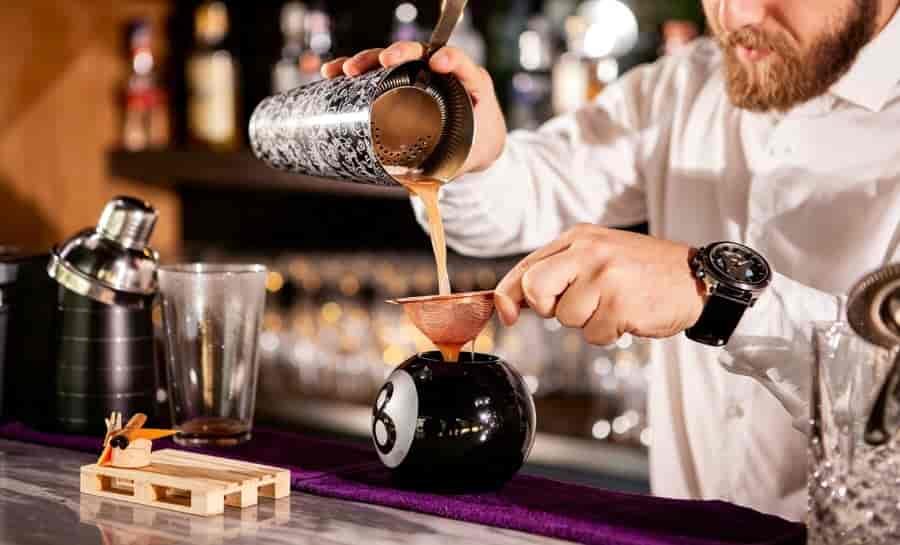
A cocktail strainer is a specialized bar tool designed to separate the liquid components of a cocktail from unwanted solids — ice chips, fruit pulp, seeds, herb fragments, or other particles — as the drink is poured from a shaker or mixing glass into the serving glass.
In short, it is the gatekeeper of texture and clarity. A properly strained cocktail is smoother, cleaner on the palate, and more visually refined. Whether used alone or in combination with another strainer (double straining), it is an essential part of both professional bar service and serious home mixology.
The 3 Types of Cocktail Strainers
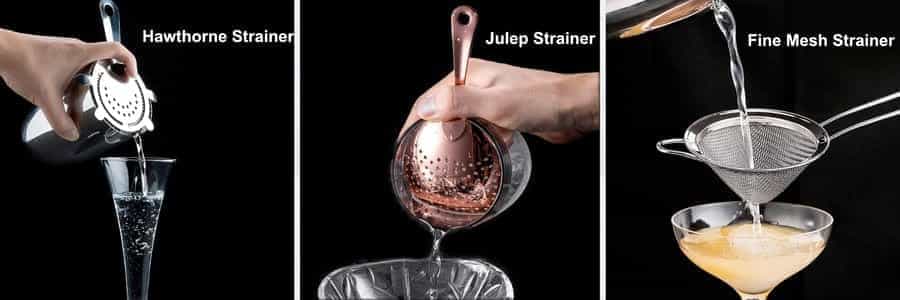
There are three common cocktail strainer types, each suited to different tools, techniques, and bar environments.
1. Hawthorne Strainer
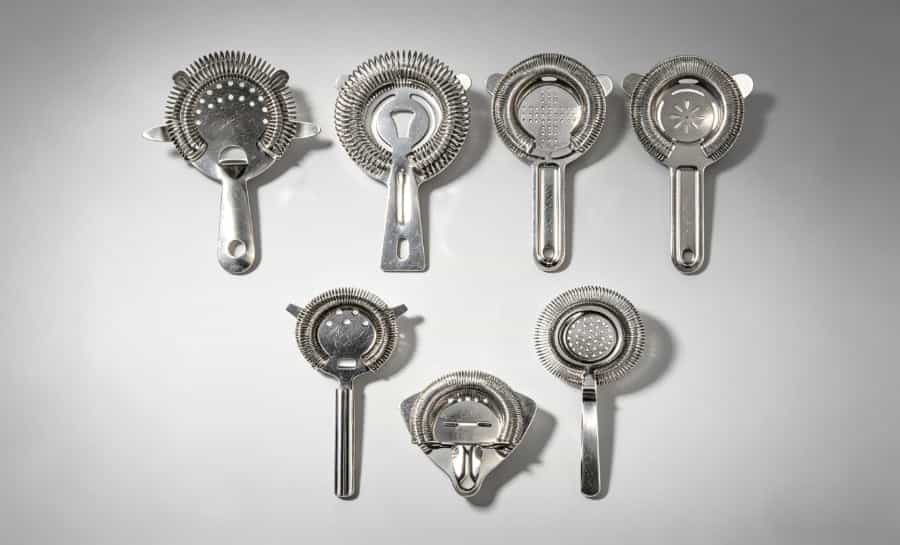
The Hawthorne strainer is the most widely used cocktail strainer in professional bars worldwide. It consists of a flat disc (the “rim”) with a handle, two or more stabilizing prongs that rest on the rim of the shaker or tin, and most importantly, a coiled metal spring fixed around the edge of the disc. It is the standard strainer for use with a Boston shaker tin.
How it works: When placed over the mouth of the shaker tin, the spring coil sits inside and filters out ice and solid particles as the liquid is poured through. The rim of the strainer does not need to seal against the glass — the spring does the filtering work.
Spring types — standard vs high-density:
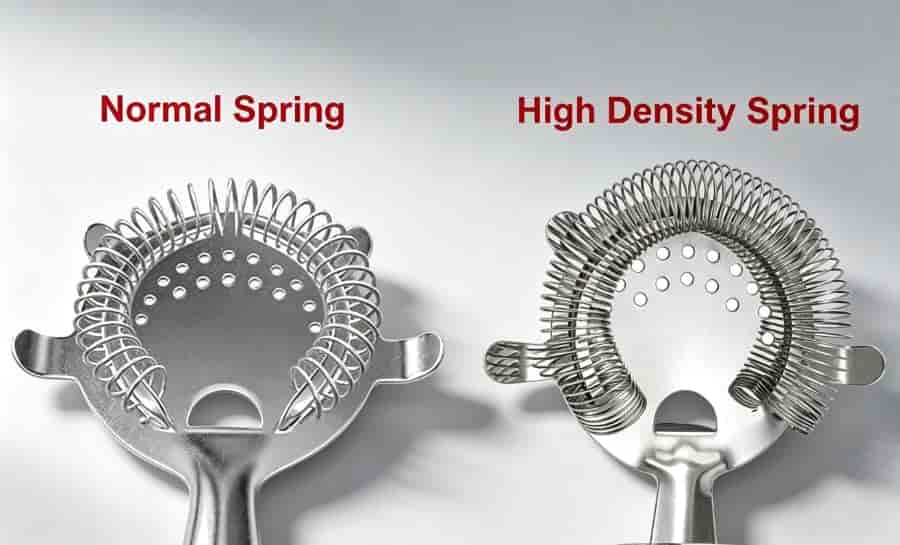
The spring coil is the key functional component of a Hawthorne strainer, and not all springs are equal:
- Standard spring — wider coil gaps, suitable for most cocktails; allows liquid to flow quickly
- High-density spring — tighter, denser coils; provides finer filtration, catching smaller particles such as fruit pulp and herb fragments without the need for a fine mesh strainer
For buyers and distributors, offering both spring variants — or specifying high-density springs for premium product lines — is a meaningful differentiator in quality-focused markets.
Pros:
- The universal professional standard — compatible with Boston shaker tins and most mixing vessels
- Spring provides effective filtration without slowing pour speed significantly
- Prongs keep the strainer stable during pouring
- Available in a wide range of finishes and spring densities
- Easy to clean
Cons:
- Spring can be difficult to clean thoroughly if coils are very tight
- Does not catch the finest particles (requires double straining with a fine mesh for ultra-smooth results)
Best for: Professional bartenders, cocktail bars, Boston shaker set pairings, and bar tool sets targeting the trade or serious home mixologists.
2. Julep Strainer
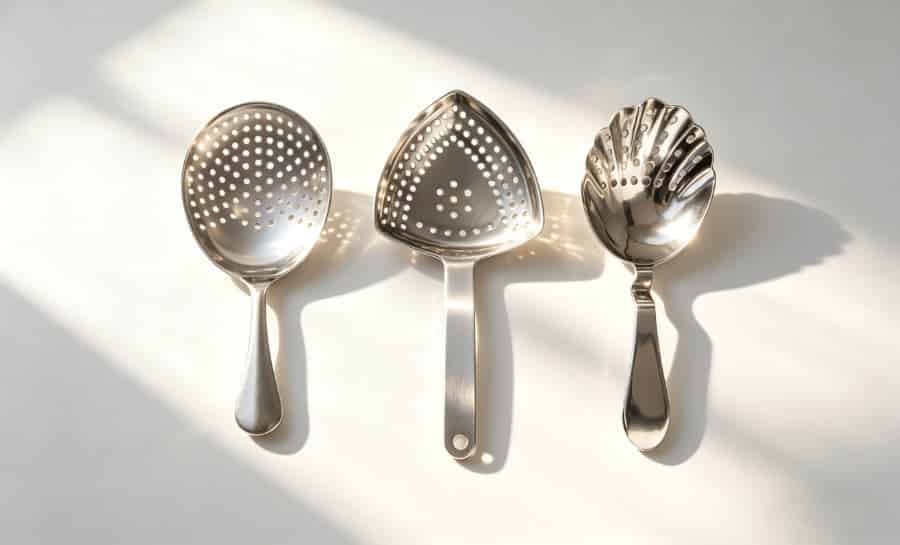
The Julep strainer is the older of the two classic strainer designs. It is shaped like a large, deep spoon with a perforated bowl — multiple small holes punched across the curved surface — and a long handle. It is traditionally paired with a mixing glass for stirred cocktails.
How it works: The strainer is held at an angle inside the mixing glass, with the perforated bowl pressed against the inside wall to form a seal. As the bartender pours, the holes allow liquid through while holding back ice and solid particles. Unlike the Hawthorne, the Julep strainer sits inside the glass rather than on top of it.
Pros:
- Classic, elegant design — associated with traditional and craft cocktail aesthetics
- Simple construction — no spring to clean or replace
- Works seamlessly with mixing glasses for stirred cocktails (Martinis, Manhattans, Negronis)
- Lower manufacturing cost than a Hawthorne strainer
Cons:
- Less versatile than a Hawthorne strainer
- Larger holes mean less filtration than a spring-based Hawthorne strainer
- Requires technique to hold securely at the right angle during pouring
Best for: Stirred cocktail programs, upscale bars with a classic or craft cocktail focus, mixing glass set pairings, and premium barware collections.
3. Fine Mesh Strainer
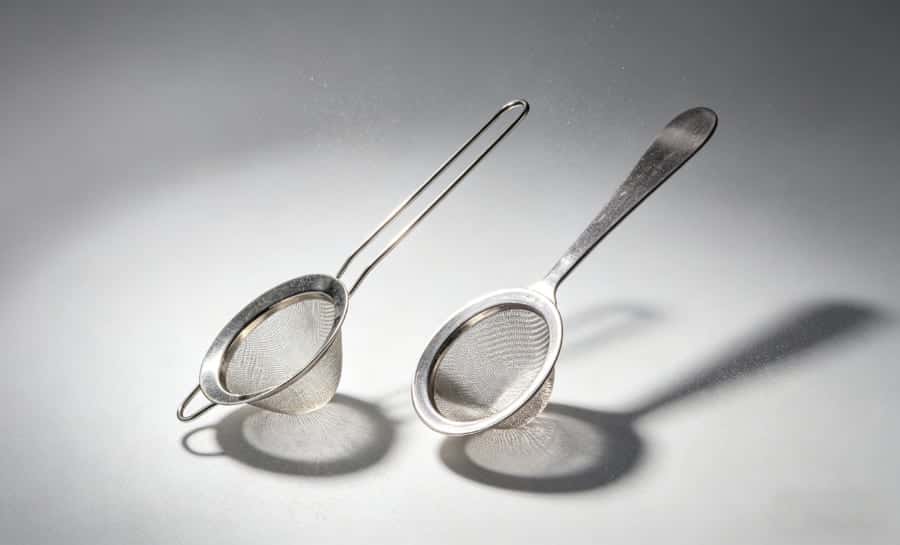
The fine mesh strainer — sometimes called a tea strainer or cocktail sieve in bar contexts — features a tightly woven metal mesh screen stretched across a small frame with a handle. It is not used to cap the shaker, but rather held over the serving glass as a secondary filter while pouring through a primary strainer (Hawthorne or Julep).
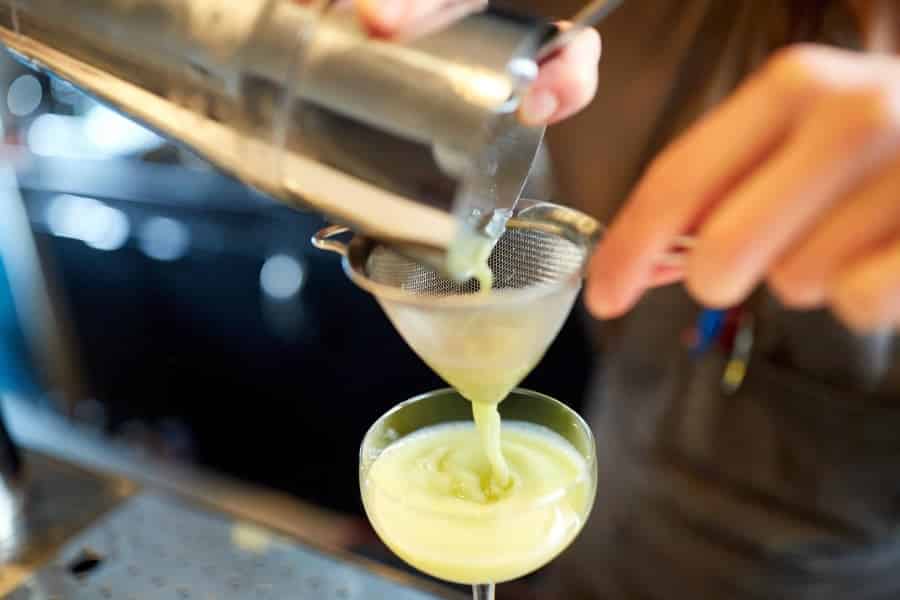
How it works: The fine mesh catches particles that pass through the primary strainer — tiny ice shards, fine pulp, herb dust, or egg white foam fragments — resulting in an exceptionally smooth, crystal-clear pour. This technique is known as double straining.
Pros:
- Produces the smoothest, cleanest possible cocktail texture
- Essential for egg white cocktails, fresh juice drinks, and herb-infused cocktails
- Simple design — easy to use and clean
- Pairs with any primary strainer
Cons:
- Cannot be used alone — always requires a primary strainer
- Fine mesh can clog quickly with pulpy ingredients, requiring rinsing between pours
- Adds an extra step to the pouring process
Best for: Craft cocktail bars focused on texture and presentation, egg white and fresh-pressed juice cocktails, premium bar programs, and complete bar tool sets.
How Cocktail Strainers Work: By Use Case
The right strainer depends on how the cocktail was prepared:
| Technique | Primary tool | Recommended strainer | Optional secondary |
|---|---|---|---|
| Shaken cocktail | Boston shaker tin | Hawthorne strainer | Fine mesh (double strain) |
| Stirred cocktail | Mixing glass | Julep strainer | Fine mesh (double strain) |
| Blended or muddled | Any vessel | Hawthorne strainer | Fine mesh (double strain) |
| Double straining | Any | Hawthorne or Julep | Fine mesh (always) |
Double straining — using a Hawthorne or Julep strainer alongside a fine mesh strainer simultaneously — is the technique of choice for cocktails where texture is paramount: citrus-heavy sours, egg white cocktails, fresh herb drinks, or any recipe where ultra-smooth delivery is the goal.
Side-by-Side Comparison: All 3 Strainer Types
| Feature | Hawthorne | Julep | Fine Mesh |
|---|---|---|---|
| Design | Disc + spring coil + prongs | Perforated spoon bowl | Woven mesh screen |
| Used with | Shaker tin | Mixing glass | Secondary (any) |
| Filtration level | Medium–high (spring dependent) | Medium | Very high |
| Double straining | Primary strainer | Primary strainer | Secondary strainer |
| Skill level | Beginner–Pro | Intermediate | Beginner |
| Best cocktail type | Shaken | Stirred | Any (as secondary) |
| Spring variant available | Yes (standard / high-density) | No | No |
What to Consider When Choosing a Cocktail Strainer
Type of cocktail program — A shaken-cocktail-focused bar needs a quality Hawthorne strainer above all. A stirred-cocktail or classic cocktail bar benefits from a Julep. A craft bar focused on texture and presentation should stock all three.
Spring density (Hawthorne) — For buyers sourcing Hawthorne strainers, spring density is a meaningful spec decision. High-density springs provide finer filtration and reduce the need for double straining, which can improve service speed in high-volume environments.
Material — Stainless steel is the professional standard for all strainer types. 304 stainless steel offers superior corrosion resistance, food-safe compliance (FDA, LFGB), and a longer service life under commercial use. 201 stainless steel is suitable for value-tier products. → See our full guide: 304 vs 201 Stainless Steel: What’s the Difference?
Surface finish — Mirror polish is the classic choice for strainers. Brushed, matte, and PVD color finishes (gold, rose gold, black, gunmetal) are increasingly popular for premium branded bar sets and gift collections.
Set composition — For bar tool set buyers and distributors, consider whether the strainer will be sold individually or bundled. A Hawthorne strainer pairs naturally with a Boston shaker; a Julep strainer pairs with a mixing glass. A complete set might include both a Hawthorne and a fine mesh strainer.
Frequently Asked Questions
What is the difference between a Hawthorne and a Julep strainer?
A Hawthorne strainer uses a coiled spring to filter and is designed for use with a shaker tin. A Julep strainer is a perforated spoon that sits inside a mixing glass and is used for stirred cocktails. Both are primary strainers — the right choice depends on the cocktail preparation method.
What is double straining?
Double straining means using two strainers simultaneously when pouring a cocktail — a primary strainer (Hawthorne or Julep) and a fine mesh strainer held over the glass. This technique removes even the finest ice shards and pulp, producing an exceptionally smooth, clear cocktail.
Do I need all three types of strainers?
For a complete professional bar setup, yes. The Hawthorne covers shaken cocktails, the Julep covers stirred cocktails, and the fine mesh is used as a secondary filter for double straining. For home bars or value-tier bar sets, a quality Hawthorne strainer alone covers most needs.
What is a high-density spring Hawthorne strainer?
A high-density spring Hawthorne strainer has a tighter, more closely wound coil compared to a standard spring. The denser coil provides finer filtration, catching smaller particles — pulp, herb fragments, fine ice — without needing a secondary fine mesh strainer. It is increasingly preferred in craft cocktail programs.
What material is best for a cocktail strainer?
304 stainless steel (18/8) is the professional standard — durable, non-reactive, food-safe, and easy to clean and sanitize. It holds up well under daily commercial use and is available with a range of surface finishes.
Sourcing Cocktail Strainers for Your Business?
If you’re a bar supplier, importer, brand owner, or hospitality distributor looking to source cocktail strainers at scale, we manufacture and wholesale stainless steel barware — including Hawthorne strainers (standard and high-density spring), Julep strainers, and fine mesh strainers — for B2B clients worldwide.
Why work with us:
- 🏭 Factory direct — competitive wholesale pricing across all strainer types and spring specifications
- 🎨 Full OEM customization — custom logo (laser engraving, screen print, embossing), surface finish (mirror, brushed, hammered, PVD color), spring density specification, and packaging
- ✅ Certified & compliant — FDA, LFGB (EU), and ISO certified; full material documentation provided
- 📦 Low MOQ — orders from 200 pcs per SKU
- 🌍 Global shipping — serving clients across North America, Europe, Australia, and Asia
Whether you need individual strainers or complete bar tool sets, we’ll help you spec the right product for your market. For a complete overview of shaker types, materials, and usage, visit our cocktail shaker guide.
Browse our cocktail strainer product range or contact us for custom OEM solutions.
Related reading: Types of Cocktail Shakers: Cobbler vs Boston vs French Explained | Types of Cocktail Jiggers: How to Choose | 304 vs 201 Stainless Steel: What’s the Difference?