Two strainers, two techniques, two very different bar setups. This guide breaks down exactly how the Hawthorne and Julep strainer differ — and helps you decide which one belongs in your bar kit or product line.
The Short Answer
- Use a Hawthorne strainer if you’re shaking cocktails with a Boston shaker tin — it’s the professional standard, works with virtually any vessel, and offers the best filtration of the two.
- Use a Julep strainer if you’re stirring cocktails in a mixing glass — it’s the traditional choice for stirred drinks and adds a classic, elegant aesthetic to the bar.
In most professional bars, both are stocked. Read on to understand why.
What Is a Hawthorne Strainer?
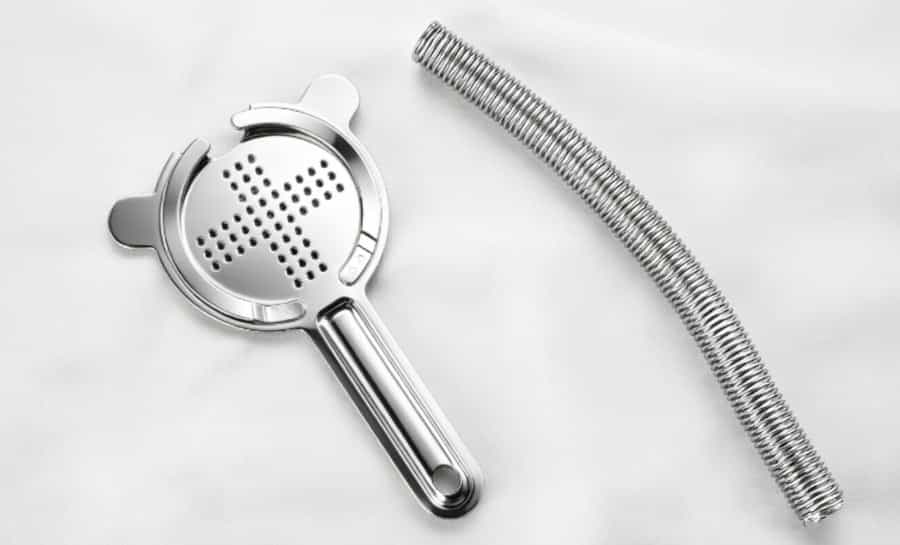
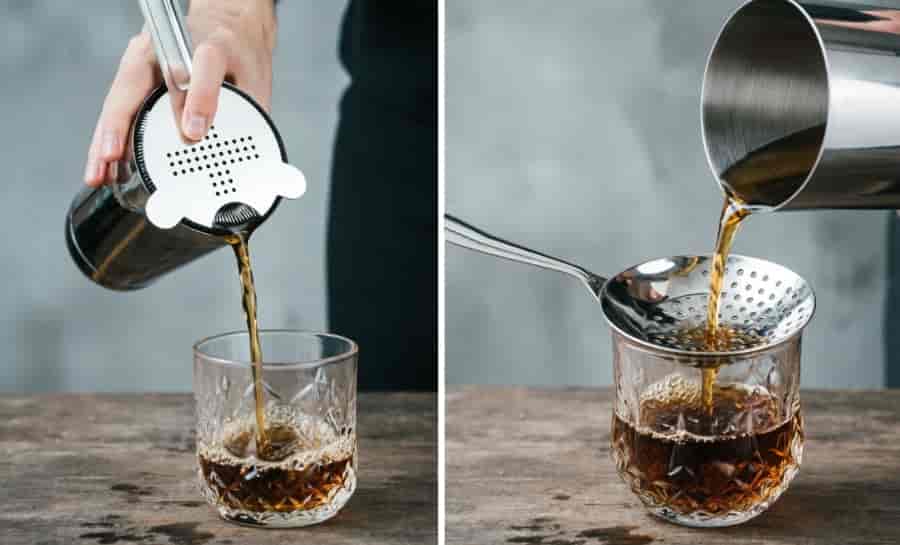
The Hawthorne strainer is the most widely used cocktail strainer in professional bars worldwide. It consists of a flat perforated disc with a handle, stabilizing prongs that rest on the rim of the shaker or tin, and most importantly a coiled metal spring fixed around the edge of the disc. The spring sits inside the vessel as liquid is poured through, filtering out ice, pulp, seeds, and other solids.
It is designed primarily for use with a Boston shaker tin, though it works with virtually any wide-mouthed vessel — cobbler shaker bases, mixing glasses, and pint glasses included.
What Is a Julep Strainer?
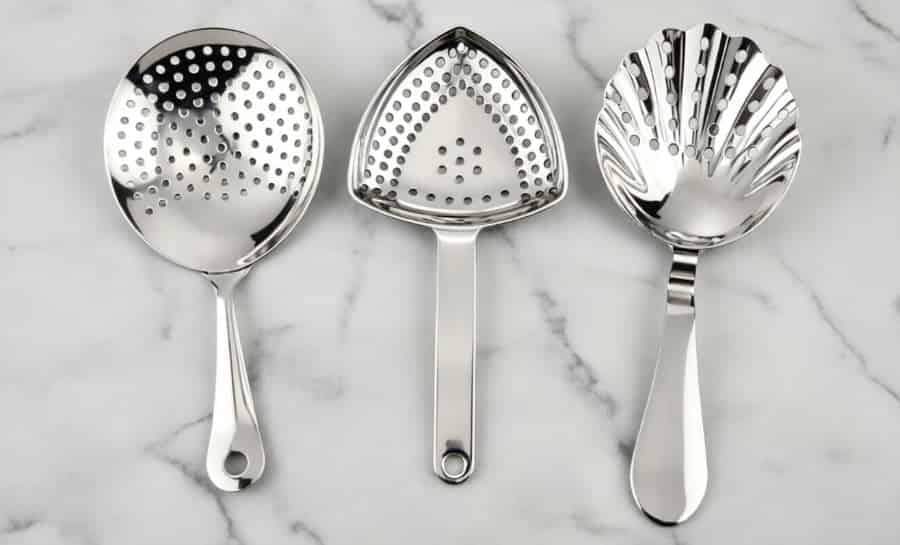
The Julep strainer is one of the oldest cocktail tools still in regular use. Shaped like a large, deep spoon with a perforated bowl — multiple small holes punched across the curved surface — and a long handle, it is designed specifically for use with a mixing glass. Rather than sitting on top of the vessel like a Hawthorne, the Julep strainer is held at an angle inside the mixing glass, with the perforated bowl pressed against the inside wall to form a seal as the drink is poured.
Its simplicity and elegance have kept it relevant for over a century, and it remains a staple in craft cocktail bars with a classic or Japanese bartending influence.
Key Differences: Hawthorne vs Julep Strainer
| Feature | Hawthorne Strainer | Julep Strainer |
|---|---|---|
| Design | Flat disc + coiled spring + prongs | Perforated spoon bowl + handle |
| Position during use | Sits on top of vessel | Held inside vessel at an angle |
| Primary pairing | Boston shaker tin | Mixing glass |
| Filtration method | Spring coil filters solids | Perforated holes filter solids |
| Filtration level | Medium–high (spring dependent) | Medium |
| Skill level | Beginner–Pro | Intermediate |
| Best cocktail type | Shaken | Stirred |
| Double straining | Yes (pair with fine mesh) | Yes (pair with fine mesh) |
| Spring variant | Standard / high-density | N/A |
| Prong variants | 2-prong / 4-prong | N/A |
| Handle variants | Standard / long handle | Standard |
| Aesthetic | Functional, modern | Classic, elegant |
Comparing Head to Head
Design and construction
The Hawthorne strainer’s defining feature is its spring coil. Wrapped around the perimeter of the disc, the spring compresses to fit inside shaker tins of varying diameters — giving it compatibility with almost any vessel without requiring a precise size match. The prongs (2 or 4 depending on the model) rest on the rim of the vessel and keep the strainer stable during pouring.
The Julep strainer’s design is radically simpler — a bowl with holes and a handle. There is no spring, no prongs, and no mechanism. It relies entirely on the bartender holding it at the correct angle inside the mixing glass to form a seal. This simplicity means fewer parts to clean and nothing to wear out, but it also means more technique is required to use it correctly.
Filtration
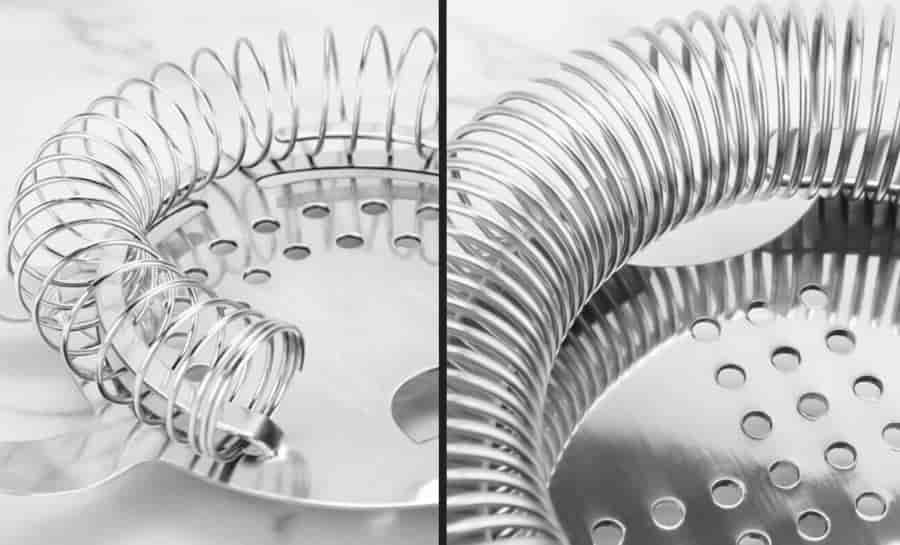
The Hawthorne strainer’s spring coil provides consistent, effective filtration across a range of cocktail types. The density of the spring determines the fineness of filtration:
Standard spring — wider coil gaps, suitable for most shaken cocktails. Fast pour speed, effective filtration of ice and large solids.
High-density spring — tighter, denser coils that catch smaller particles such as citrus pulp, herb fragments, and fine ice shards. Reduces or eliminates the need for double straining in many applications.
The Julep strainer’s perforated holes provide adequate filtration for stirred cocktails, which typically contain less particulate matter than shaken drinks — stirred cocktails use whole ice cubes and no muddled or fresh-pressed ingredients, so the simpler filtration is sufficient.
For heavily pulped, herb-infused, or egg white cocktails, both strainers benefit from double straining with a fine mesh strainer as a secondary filter.
Compatibility and versatility
The Hawthorne strainer wins on versatility. Its spring-compression mechanism allows it to fit Boston shaker tins, cobbler shaker bases, mixing glasses, and most other wide-mouthed bar vessels. In a busy bar where speed matters, bartenders can move a Hawthorne strainer between different vessels without thinking about fit.
The Julep strainer is less versatile — it is specifically designed for mixing glasses and does not work well with shaker tins, which have a narrower opening that makes it difficult to hold the Julep at the correct angle. This specialization is not a flaw, just a design constraint that makes pairing decisions straightforward: Julep goes with the mixing glass, always.
Ease of use
The Hawthorne strainer is more accessible for beginners. Placing it on top of a shaker tin and pouring is intuitive — the prongs keep it in place and the spring does the filtering work automatically. Learning to use it well takes minutes.
The Julep strainer requires more technique. Holding it at the right angle inside the mixing glass to form an effective seal while simultaneously pouring into a serving glass takes practice. Applied incorrectly, ice can slip past the bowl during the pour. Once mastered it is perfectly efficient, but the learning curve is steeper than the Hawthorne.
Cleaning
Both strainers are easy to clean under running water. The Hawthorne strainer’s spring coil requires attention — pulp and herb fragments can lodge in the coil, particularly in high-density spring models, and need to be rinsed or brushed out promptly after use. The Julep strainer’s open perforated bowl clears quickly with a rinse and has no narrow gaps to trap residue.
Aesthetic
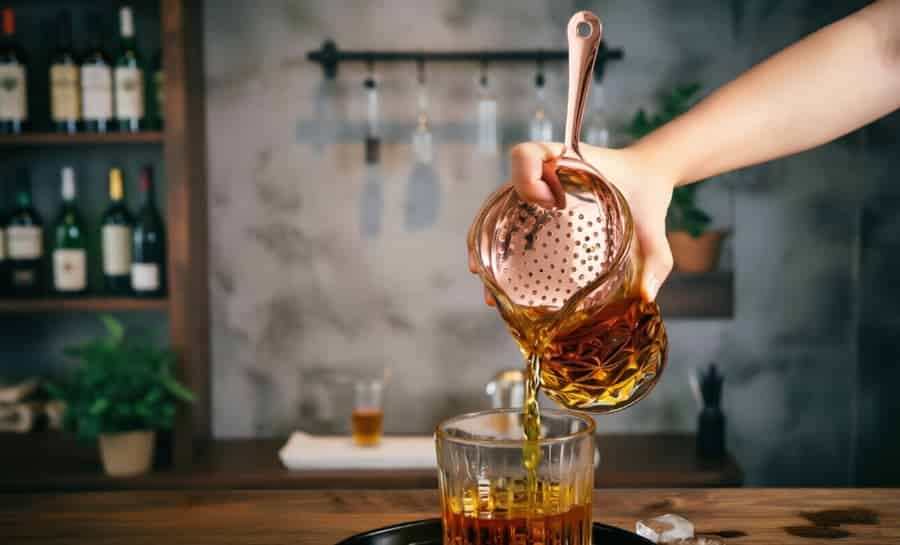
The Julep strainer has a timeless, understated elegance that resonates strongly in craft cocktail bars, Japanese-influenced programs, and upscale hospitality settings. Its spoon-like profile and simple form carry a sense of history and intentionality.
The Hawthorne strainer reads as modern and functional — its spring coil and disc design communicate professional efficiency. In premium bar product lines, the visual appeal of both strainer types serves different market aesthetics equally well.
Hawthorne Strainer Variants: 2-Prong vs 4-Prong
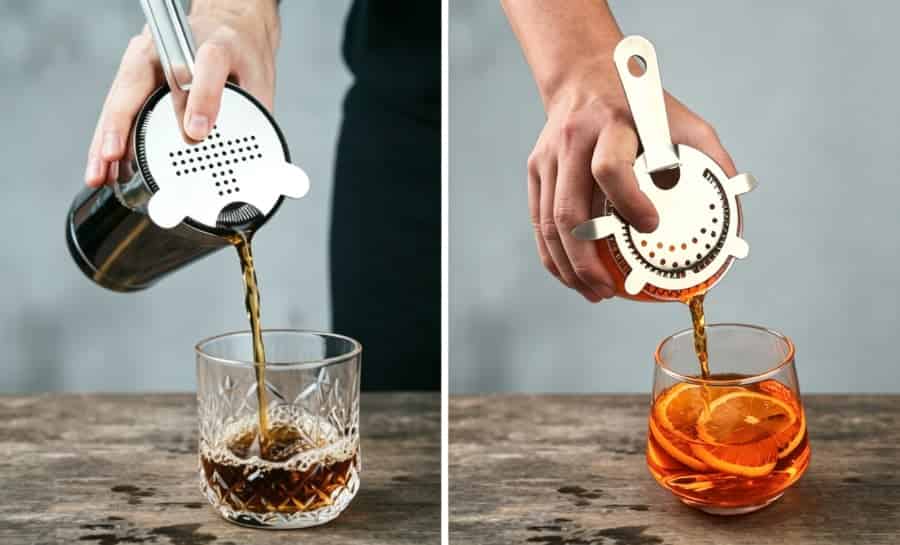
One design decision specific to Hawthorne strainers is the number of stabilizing prongs:
2-prong Hawthorne strainer — the classic and most widely used configuration. Two prongs rest on opposite sides of the vessel rim, keeping the strainer in position during pouring. Lightweight, fast to place, and the standard choice for most professional applications.
4-prong Hawthorne strainer — four prongs distribute contact points evenly around the rim, providing greater stability during vigorous pouring and reducing the chance of the strainer shifting position mid-pour. Preferred by bartenders who shake hard or work quickly in high-volume environments. Also a popular upgrade specification for premium bar set bundles.
For most applications the 2-prong is entirely sufficient. The 4-prong is a meaningful upgrade for speed-focused professional use and for buyers looking to differentiate a premium product tier.
Hawthorne Strainer Handle Options
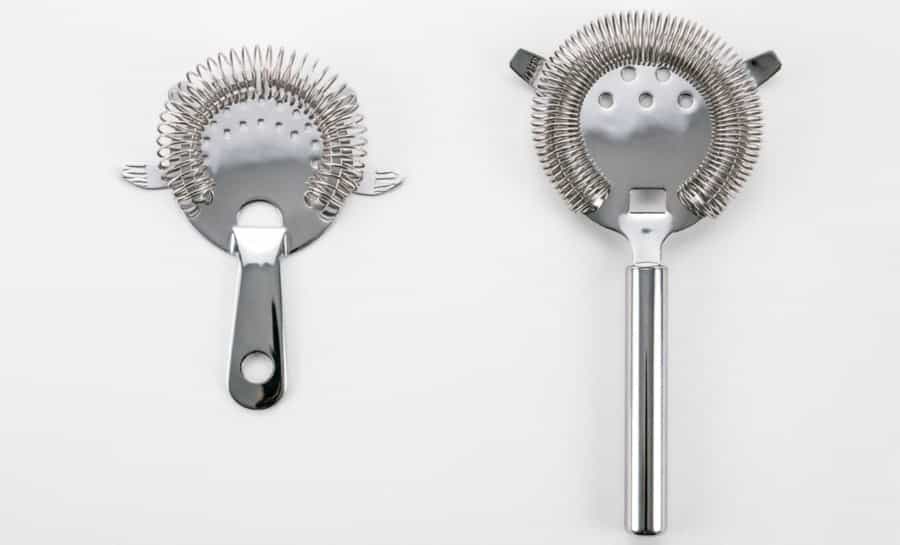
Hawthorne strainers are available with different handle lengths, which affects ergonomics and bar workflow:
Standard / short handle — the traditional configuration. Compact, easy to store, and the default choice for most bar setups. Works well for bartenders who keep the strainer close to the shaker during pouring.
Long handle — extends the bartender’s reach, useful in bar setups where the shaker and serving glass are at different heights or distances. Also provides more leverage for a controlled, stable pour. Increasingly popular in premium and ergonomic-focused bar tool collections.
Which Is Right for Your Bar Program?
Use a Hawthorne strainer if:
- Your primary technique is shaking cocktails with a Boston shaker tin
- You want maximum versatility — one strainer that works with any vessel
- You need reliable filtration for shaken drinks including citrus, herbs, and egg white cocktails
- You want the option of a high-density spring for finer filtration without double straining
- You are equipping a high-volume commercial bar where speed and efficiency matter
Use a Julep strainer if:
- Your primary technique is stirring cocktails in a mixing glass
- Your bar program focuses on stirred classics — Martinis, Manhattans, Negronis, Old Fashioneds
- You value the classic aesthetic and historical resonance of the tool
- You want a simple, low-maintenance strainer with no spring to clean
Stock both if:
- You run a full-service cocktail bar offering both shaken and stirred drinks
- You are building complete bar tool sets for retail or hospitality supply
- You want to offer customers a professional-grade setup that covers all techniques
In practice, most serious cocktail bars stock at least one of each — the Hawthorne for the shaker station and the Julep alongside the mixing glass.
Side-by-Side Summary
| Hawthorne | Julep | |
|---|---|---|
| Best with | Boston shaker tin | Mixing glass |
| Best for | Shaken cocktails | Stirred cocktails |
| Filtration | Spring coil (standard or high-density) | Perforated bowl |
| Variants | 2-prong / 4-prong, short / long handle, standard / high-density spring | Standard |
| Skill needed | Low | Moderate |
| Double straining | Yes (+ fine mesh) | Yes (+ fine mesh) |
| Aesthetic | Modern / professional | Classic / elegant |
Frequently Asked Questions
Can I use a Hawthorne strainer with a mixing glass?
Yes. While the Hawthorne strainer is designed primarily for Boston shaker tins, its spring coil compresses to fit most mixing glasses as well. Many bartenders use a Hawthorne strainer for both shaken and stirred cocktails, particularly in high-volume settings where switching tools slows service.
Can I use a Julep strainer with a shaker tin?
Not effectively. The Julep strainer is designed to be held inside a mixing glass at a specific angle. Boston shaker tins have a narrower opening and a different interior profile that makes this technique difficult to execute correctly. For shaker tins, a Hawthorne strainer is always the right choice.
What is a high-density spring Hawthorne strainer?
A high-density spring Hawthorne strainer has a tighter, more closely wound coil compared to a standard spring. The denser coil provides finer filtration, catching smaller particles — pulp, herb fragments, fine ice — reducing or eliminating the need for double straining. It is increasingly preferred in craft cocktail programs. We manufacture both standard and high-density spring variants to order.
What is the difference between a 2-prong and 4-prong Hawthorne strainer?
Both function identically — the prongs rest on the rim of the vessel to keep the strainer in position during pouring. A 4-prong strainer distributes contact points more evenly around the rim, providing slightly greater stability. It is a popular upgrade for premium bar sets and high-volume professional use.
Do I need a fine mesh strainer as well?
For most shaken and stirred cocktails, a Hawthorne or Julep strainer alone is sufficient. However, for cocktails where texture is paramount — egg white cocktails, fresh-pressed juice drinks, heavily muddled or herb-infused recipes — double straining with a fine mesh strainer as a secondary filter produces a noticeably smoother, clearer result.
Which strainer is better for a beginner?
The Hawthorne strainer. Placing it on top of a shaker tin and pouring is intuitive and requires minimal technique. The Julep strainer requires practice to hold at the correct angle inside the mixing glass consistently.
Sourcing Hawthorne and Julep Strainers for Your Business?
If you’re a bar supplier, importer, brand owner, or hospitality distributor looking to source cocktail strainers at scale, we manufacture and wholesale the full range of Hawthorne and Julep strainer variants for B2B clients worldwide.
Our Hawthorne strainer range includes:
- 2-prong and 4-prong configurations
- Standard and long handle options
- Standard spring and high-density spring (to order)
- Full range of surface finishes: mirror polish, brushed, PVD color (gold, rose gold, black, gunmetal)
Our Julep strainer is available in standard configuration with the same surface finish options.
All strainers are produced in 18/8 (304) stainless steel with food-safe spring coils, and support custom logo engraving, screen printing, and mixed-container orders.
Why work with us:
- 🏭 Factory direct — competitive wholesale pricing across all strainer styles and specifications
- 🎨 Full OEM customization — custom logo, surface finish, spring density, prong configuration, and packaging
- ✅ Certified & compliant — FDA, LFGB (EU), and ISO certified; full material documentation provided
- 📦 Low MOQ — orders from 200 pcs per SKU
- 🌍 Global shipping — serving clients across North America, Europe, Australia, and Asia
Browse our cocktail strainer product range or contact us for custom OEM solutions.
Related reading: Types of Cocktail Strainers: Hawthorne, Julep, and Fine Mesh Explained | Types of Cocktail Shakers: Cobbler vs Boston vs French Explained | Cocktail Shaker Guide: Types, Materials & How to Choose