Building a barware brand or expanding your product line? Understanding the difference between OEM and ODM manufacturing is the first step to making the right sourcing decision. This guide explains both models clearly — and helps you choose the right approach for your business.
What Is OEM Barware?
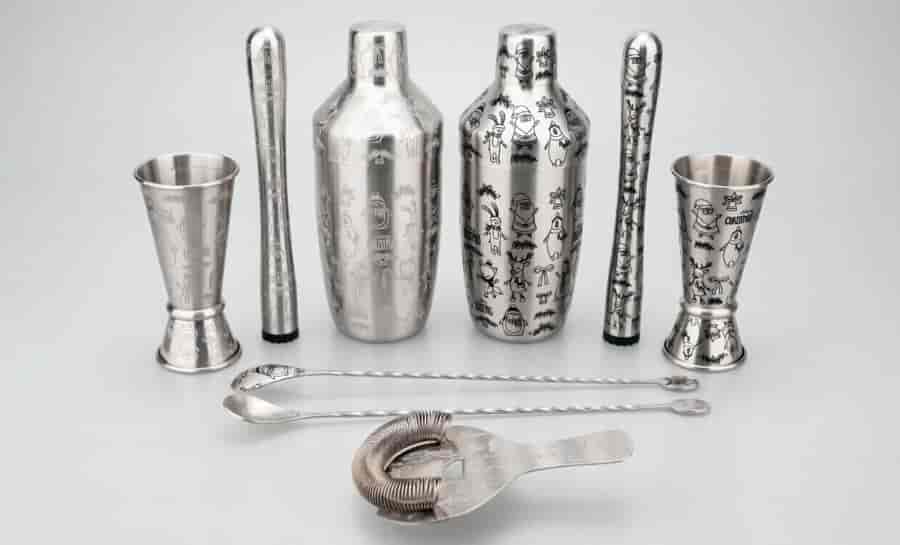
OEM stands for Original Equipment Manufacturer. In the barware context, OEM means the manufacturer produces products to the buyer’s exact specifications — the buyer provides the design, dimensions, materials, finish, logo, and packaging requirements, and the manufacturer executes production accordingly.
In an OEM arrangement, the intellectual property belongs to the buyer. The product design, branding, and packaging are owned and controlled by the brand — the manufacturer’s role is to produce it precisely and consistently to specification.
What buyers typically specify in an OEM barware order:
- Product type and dimensions (e.g. 750ml Boston shaker, custom height and diameter)
- Material and grade (e.g. 304 stainless steel 18/8)
- Surface finish (e.g. mirror polish, brushed, hammered, electroplating, PVD, spray painting color)
- Logo application method (laser engraving, screen printing, embossing)
- Logo placement, size, and artwork file
- Packaging design (retail box, gift box, insert, outer carton)
- Quality standards and inspection requirements
- Delivery timeline and shipping terms
What Is ODM Barware?
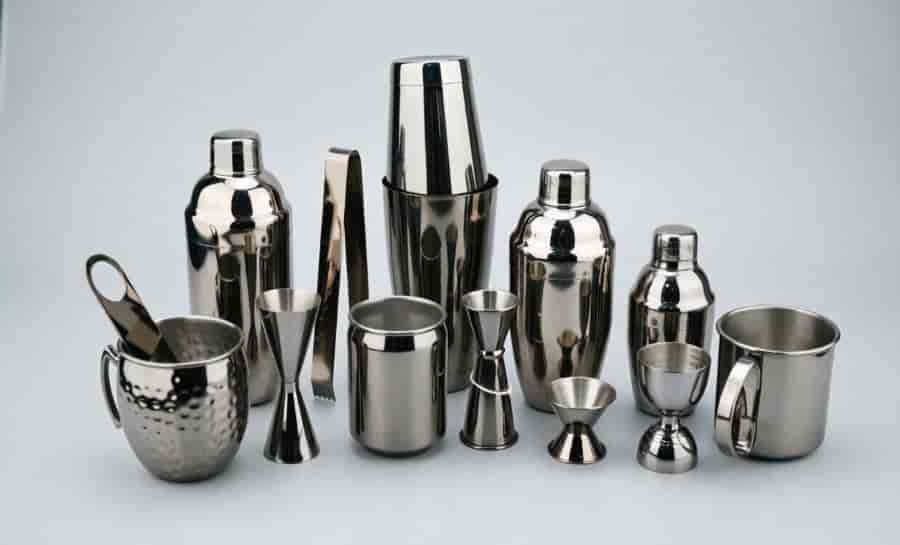
ODM stands for Original Design Manufacturer. In the barware context, ODM means the buyer selects from the manufacturer’s existing product designs and applies their own branding — logo, packaging, and sometimes color or finish — to create a product that carries their brand identity.
The manufacturer owns the product design and tooling. The buyer is licensing or adopting an existing design rather than creating a new one. This makes ODM significantly faster and lower in upfront cost compared to OEM, while still allowing meaningful brand differentiation through logo, finish, and packaging choices.
What buyers typically customize in an ODM barware order:
- Logo application (laser engraving, screen printing, embossing)
- Surface finish selection from available options
- Electroplating, PVD, Spray Painting color selection
- Packaging design (custom box, sleeve, or label on standard packaging)
- Product bundling (e.g. shaker + jigger + strainer as a set)
OEM vs ODM: Key Differences at a Glance
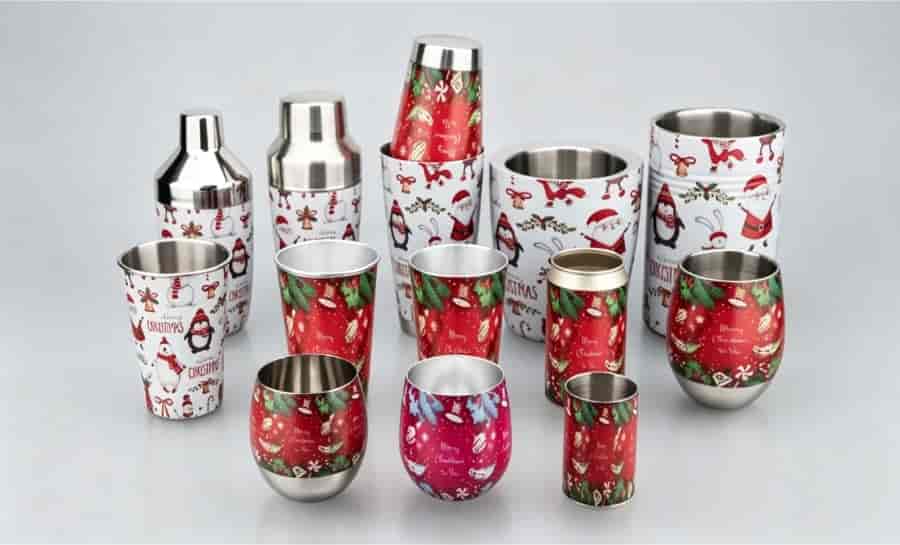
| OEM | ODM | |
|---|---|---|
| Product design | Buyer’s own design | Manufacturer’s existing design |
| Design IP ownership | Buyer | Manufacturer |
| Customization level | Full — dimensions, shape, material, finish, logo, packaging | Partial — logo, finish, color, packaging |
| Upfront tooling cost | Yes (new tooling required for unique shapes) | No (existing tooling used) |
| Minimum order quantity | Higher (tooling amortization) | Lower |
| Lead time | Longer (design + tooling + production) | Shorter (production only) |
| Unit cost | Higher for small runs; competitive at scale | Lower — shared tooling cost |
| Brand differentiation | Maximum — product is exclusive to the buyer | Moderate — design may be sold to multiple buyers |
| Best for | Established brands with unique design vision | Startups, retailers, distributors entering barware |
| Time to market | 45–90 days (depending on complexity) | 20–35 days |
When to Choose OEM
OEM is the right model when your brand requires a product that is distinctively yours — a shape, size, or design feature that sets your product apart from anything available in the market.
OEM makes sense if:
- You have a specific product vision that cannot be achieved by customizing an existing design
- You are building a brand where product design is a core differentiator — not just the logo
- You are at a scale where tooling costs are justified by volume (typically 1,000+ pcs per SKU)
- You want full exclusivity — the exact product design is not available to other buyers
- You are developing a product line with unique ergonomics, dimensions, or functional features
- Your target market is premium retail or hospitality, where product uniqueness commands a price premium
Typical OEM timeline with us: Design review and approval → tooling fabrication → sample production → sample approval → bulk production → quality inspection → shipping. For standard products with minor modifications, 30–45 days. For fully new designs requiring new tooling, 45–70 days.
When to Choose ODM
ODM is the right model when your priority is speed to market, lower upfront investment, and brand flexibility — and when the product design itself is less critical than the brand experience around it.
ODM makes sense if:
- You are launching a barware brand for the first time and want to test the market before committing to custom tooling
- You are a retailer or distributor adding branded barware to your product assortment
- Your brand differentiation comes from logo, color, packaging, and brand story — not product design
- You want to move quickly — 30 days from order confirmation to delivery
- Your MOQ requirements are lower and tooling investment is not justified at current volume
- You want to offer a range of products (shakers, jiggers, strainers, bar sets) without investing in tooling for each
Typical ODM timeline with us: Product selection and specification → artwork approval → sample confirmation (if required) → bulk production → quality inspection → shipping. For standard catalog products: 30 days from order confirmation.
Real-World Example: How Brand Owners Use ODM to Launch Barware Lines
Our ODM clients are primarily brand owners and retailers — companies building a barware product line under their own brand without starting from scratch on product design.
A typical project looks like this:
A brand owner in the United States approaches us wanting to launch a premium cocktail shaker set under their own brand. They select three products from our catalog — a Cobbler shaker, a double jigger with rolled edge, and a Hawthorne strainer. They specify Black PVD finish, laser-engraved logo on each piece, and a custom designed gift box. We produce a pre-production sample for approval, then move to bulk production. Total lead time: 30 days from order confirmation.
We have supplied ODM barware to brand clients across the United States, Mexico, Australia, the Netherlands, Poland, and the United Kingdom — covering retail, e-commerce, hospitality supply, and corporate gifting channels.
The most commonly customized elements across these projects:
- Color: Gunmetal Black and Rose Gold plating are the most requested finishes for branded barware
- Logo: Laser engraving is the most popular method — durable, premium appearance, no ink
- Packaging: Custom retail gift boxes are standard for brand-building clients; bulk pack for distribution clients
Customization Options: What You Can Specify
Whether you choose OEM or ODM, the following customization options are available across our full barware range:
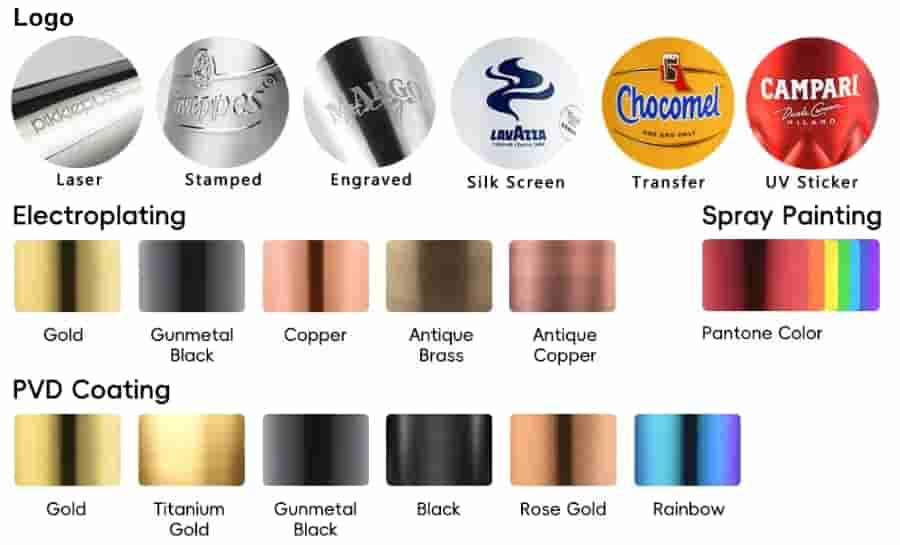
Logo Application Methods
| Method | Best for | Durability | Notes |
|---|---|---|---|
| Laser engraving | Premium brands, professional barware | Permanent | Removes surface material to reveal base steel; subtle, refined look |
| Screen printing | Bold logos, multi-color designs | Good | Ink-based; best for flat surfaces |
| Embossing | Tactile, raised logo effect | Permanent | Requires tooling; adds premium feel |
| Debossing | Recessed logo effect | Permanent | Requires tooling |
Surface Finish Options
- Mirror polish, Brushed, Hammered, Vintage
- Electroplating color: Copper, Gold, Gunmetal, Antique Copper, Antique Brass
- PVD color: Rose Gold, Gold, Titanium Gold, Black, Gunmetal, Rainbow
- Spray Painting color: All Pantone colors available
Packaging Options
- Custom retail gift box (full color print, insert tray)
- Custom kraft or rigid box
- Custom sleeve over standard box
- Bulk pack (for distribution / hospitality supply)
- Custom outer carton with brand label
Product Bundling
- Single product with custom branding
- 2-piece, 3-piece, or 5-piece bar sets
- Full bar tool kit (shaker + jigger + strainer + bar spoon + muddler)
- Custom bundle configuration per buyer’s requirements
OEM vs ODM: Which Is Right for Your Business?
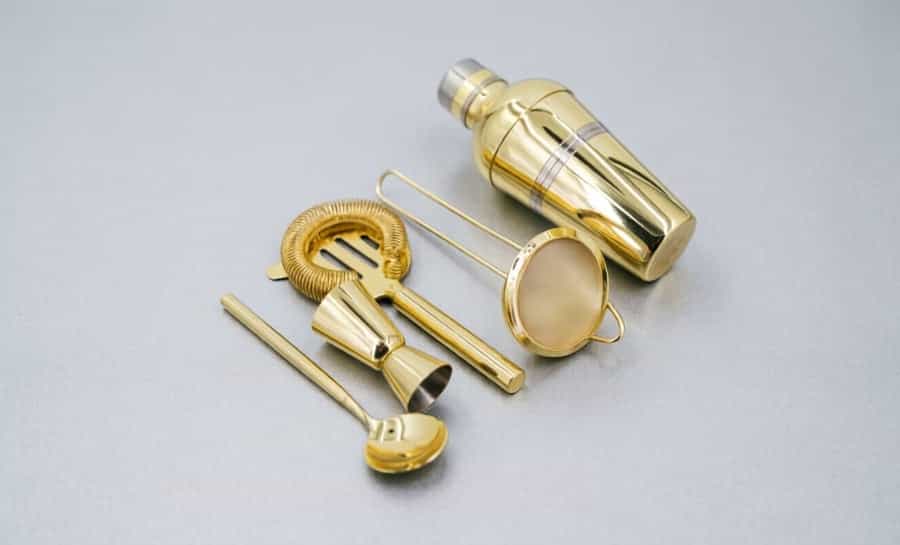
Choose ODM if:
- You are launching or testing a barware brand
- You want to go to market in 30 days
- Your differentiation is logo, color, and packaging — not product shape
- You want lower upfront investment and MOQ
Choose OEM if:
- You have a specific product design vision
- You are at sufficient volume to justify tooling
- Product exclusivity is important to your brand strategy
- You are building a long-term product line with proprietary designs
Not sure which fits your situation? Most of our brand clients start with ODM — selecting from our catalog, applying their branding, and launching quickly to test market response. Once a product line is validated and volume grows, some clients transition specific SKUs to OEM to create exclusive designs that competitors cannot replicate.
This staged approach — ODM first, OEM later — is a practical and low-risk way to build a barware brand without overcommitting upfront investment.
The OEM/ODM Process: Step by Step
Step 1: Initial inquiry Share your product requirements — type, quantity, finish, logo, packaging, target market, and timeline. The more detail you provide upfront, the faster we can give you an accurate quote.
Step 2: Quote and specification confirmation We provide a detailed quote covering unit price, tooling cost (OEM only), sample cost, lead time, and shipping options. Once agreed, we confirm the full specification in writing.
Step 3: Artwork and sample You provide logo artwork (AI or SVG preferred for engraving; PNG/PDF for print). We produce a pre-production sample for your approval before bulk production begins.
Step 4: Sample approval You review the physical sample and confirm approval — or request adjustments. We do not proceed to bulk production without written sample approval.
Step 5: Bulk production Production begins after sample approval and deposit payment. We maintain communication throughout with production updates.
Step 6: Quality inspection All orders go through quality inspection before shipping — checking finish consistency, logo placement, dimensions, and packaging.
Step 7: Shipping We ship via your preferred method — sea freight (most economical for large orders), air freight (faster), or express courier (small orders and samples). We can ship to your warehouse, freight forwarder, or Amazon FBA directly.
Frequently Asked Questions
What is the minimum order quantity for OEM and ODM barware?
Our standard MOQ is 200 pcs per SKU for ODM orders. OEM MOQ varies depending on whether new tooling is required — contact us with your specifications for an accurate quote.
How long does it take to produce custom barware?
For ODM orders (catalog products with custom logo and finish): 30 days from order confirmation and artwork approval. For OEM orders with new tooling: 45–70 days depending on design complexity.
Do you provide samples before bulk production?
Yes. We always produce a pre-production sample for buyer approval before proceeding to bulk. Sample cost is typically credited against the bulk order.
Can I mix different products in one order?
Yes. Mixed product orders are available — for example, a bar set combining shakers, jiggers, and strainers with the same logo and finish. Contact us to discuss minimum quantities per SKU in a mixed order.
What file format do you need for logo artwork?
For laser engraving: AI or SVG (vector format) preferred. For screen printing: high-resolution PNG or PDF. We can advise on artwork requirements when you submit your inquiry.
Do you offer exclusivity on ODM products?
Standard ODM catalog products are available to multiple buyers. If you require exclusivity on a specific design, we can discuss OEM production of that design — which gives you full ownership of the tooling and product specification.
Which markets do you currently supply?
We supply brand owners, retailers, and distributors across North America (US, Mexico), Europe (UK, Netherlands, Poland, and wider EU), Australia, and Asia. Our products comply with FDA (US), LFGB (EU), and ISO standards, supporting regulatory requirements across these markets.
Start Your OEM or ODM Barware Project
If you’re a brand owner, retailer, or distributor ready to launch or expand a barware product line, we’re ready to support your project — from product selection and specification through to delivery.
What to include in your first inquiry:
- Product type(s) and approximate quantities
- Target finish and color
- Logo requirements (engraving, print, or embossing)
- Packaging requirements
- Target market and any certification requirements
- Timeline
The more detail you share upfront, the faster we can respond with an accurate quote and timeline.
Browse our barware product range or contact us for custom OEM solutions.
Related reading: Barware Surface Finishes: A Complete Guide to Stainless Steel Coating & Finishing Options | 304 vs 201 Stainless Steel for Cocktail Shakers: What’s the Difference? | Cocktail Shaker Guide: Types, Materials & How to Choose